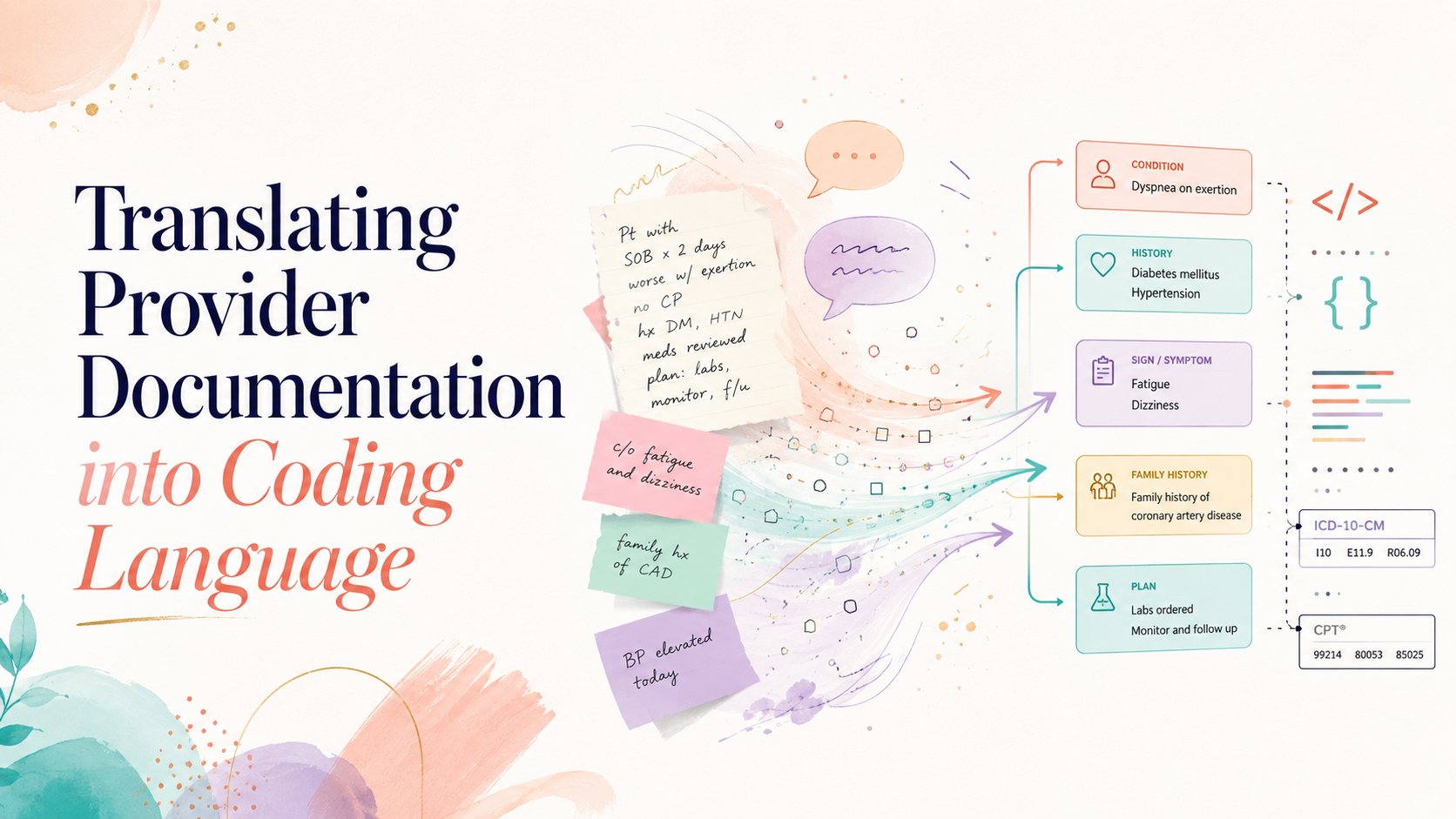
Medical providers and medical coders read the same chart for different reasons.
The provider documents the patient’s story:
- What brought the patient in.
- What the provider observed.
- Which conditions were considered.
- What tests and treatments were ordered.
- What conclusions were reached.
- What should happen next.
The coder must translate that clinical story into reportable coding concepts.
That does not mean replacing every medical phrase with a code.
It means determining:
- What is actually documented.
- Whether the condition is current and relevant.
- How certain the diagnosis is.
- Which relationships have been established.
- What level of specificity is supported.
- Which coding conventions apply.
- Whether clarification is needed.
The FY 2026 ICD-10-CM guidelines emphasize that accurate coding depends on consistent, complete documentation and review of the entire record to determine the reason for the encounter and the conditions treated.
The challenge for newer coders is learning to recognize the difference between what the chart says clinically and what the documentation supports for coding.
Clinical Language Is Not Always Coding Language
Providers write for patient care, not for the Alphabetic Index.
A note may include phrases such as:
- Shortness of breath on exertion.
- History of heart failure.
- Possible pneumonia.
- Elevated laboratory value.
- Status post surgery.
- Concern for infection.
- Acute-on-chronic pain.
- Rule out fracture.
- Swelling of both lower extremities.
- Findings consistent with dehydration.
Each phrase creates a different coding question.
Some describe symptoms.
Some describe confirmed diagnoses.
Some express uncertainty.
Some identify history.
Some describe clinical findings that may or may not be reportable.
Some establish relationships between conditions.
Others require clarification before a code can be assigned confidently.
A coder’s job is not to make the language sound more medical or more specific.
The job is to preserve the meaning of the documentation while applying the rules of the classification.
Start With the Complete Clinical Thought
Avoid translating one word or phrase in isolation.
Consider this abbreviated documentation:
Patient presents with shortness of breath on exertion and swelling in both legs. History of heart failure. Weight increased four pounds in three days.
A new coder may immediately search for heart failure because it appears in the note.
But several questions remain:
- Is heart failure an active diagnosis or only past history?
- Did the provider evaluate it during this encounter?
- Was an acute condition documented?
- Were the symptoms linked to heart failure?
- Did the provider establish another diagnosis?
- Is this an outpatient encounter with an uncertain assessment?
- What does the final diagnostic statement say?
The correct coding direction cannot be determined from the phrase “history of heart failure” alone.
Read the assessment, plan, test results, reassessments, and final disposition before deciding what the clinical language means for coding.
Step 1: Identify Who Documented the Information
Diagnosis code assignment is generally based on documentation from the physician or other qualified healthcare practitioner legally accountable for establishing the diagnosis.
The FY 2026 guidelines provide limited exceptions for information that may come from other clinicians, including certain details involving:
- Body mass index.
- Pressure-ulcer stage.
- Non-pressure-ulcer depth.
- Coma scale.
- NIH Stroke Scale.
- Certain social determinants of health.
- Laterality.
- Blood-alcohol level.
- Underimmunization status.
- Firearm-injury intent.
This means a coder may review the entire chart for context, but should not automatically turn a nursing observation, laboratory result, imaging finding, or medication order into a provider diagnosis.
Ask:
- Who documented the condition?
- Is that person authorized to establish the diagnosis?
- Does one of the recognized documentation exceptions apply?
- Is the information consistent across the record?
- Is clarification required?
A nursing note may help explain what happened during the encounter. It does not necessarily establish the final diagnosis.
Step 2: Determine What Type of Information You Are Reading
Before searching for a code, classify the phrase.
Is it:
- A symptom?
- A sign?
- A confirmed diagnosis?
- An uncertain diagnosis?
- A chronic condition?
- A historical condition?
- A status?
- An abnormal test result?
- A procedure?
- A complication?
- A reason for the encounter?
This simple step prevents many translation errors.
Example: “Shortness of breath”
This is a documented symptom.
It should not automatically be translated into a respiratory or cardiac diagnosis.
Example: “History of asthma”
This phrase requires context.
It may describe a past condition, an existing chronic condition, or information that is merely part of the patient’s background.
Determine whether asthma is current, whether it affected the encounter, and how the provider described it elsewhere in the record.
Example: “Possible pneumonia”
This is an uncertain diagnosis.
Whether it can be coded as though confirmed depends on the setting and applicable rules.
Example: “Elevated laboratory result”
An abnormal result is not automatically a diagnosis.
For outpatient reporting, abnormal laboratory, imaging, pathology, and other diagnostic findings generally are not coded unless the provider indicates their clinical significance. When the result has led to further evaluation or treatment but its significance remains unclear, a query may be appropriate.
Step 3: Determine the Level of Diagnostic Certainty
Words expressing uncertainty matter.
Watch for terms such as:
- Possible.
- Probable.
- Suspected.
- Questionable.
- Rule out.
- Consistent with.
- Compatible with.
- Concern for.
- Cannot exclude.
- Working diagnosis.
In outpatient settings, diagnoses documented with uncertain language are not coded as confirmed. Instead, code the condition to the highest degree of certainty known for the encounter, which may be a documented sign, symptom, abnormal finding, or other reason for the visit.
Example
The provider documents:
Suspected pneumonia. Patient has fever and productive cough.
For an outpatient encounter, do not automatically translate “suspected pneumonia” into a confirmed pneumonia code.
The documented symptoms may represent the highest degree of certainty.
Qualifying inpatient facility rules differ, so always verify the setting before applying uncertainty guidance.
Step 4: Do Not Upgrade the Diagnosis
Providers do not always use the most specific terminology available in the code set.
That does not give the coder permission to create greater specificity.
Do not automatically translate:
- “Kidney disease” into a particular stage.
- “Anemia” into a specific type.
- “Infection” into sepsis.
- “Altered mental status” into encephalopathy.
- “Elevated glucose” into diabetes.
- “Chest discomfort” into angina.
- “History of depression” into active major depressive disorder.
- “Postoperative pain” into a procedural complication.
The documentation must support the code selected.
The FY 2026 guidelines state that unspecified codes are appropriate when they most accurately represent what is known at the time of the encounter. Selecting a more specific code that is not supported by the medical record is inappropriate.
“Unspecified” does not always mean the coder failed to research.
Sometimes it is the most accurate translation of the provider’s documentation.
Step 5: Preserve the Provider’s Important Qualifiers
Small words can change code selection.
Pay attention to documentation describing:
- Acute.
- Chronic.
- Acute on chronic.
- Recurrent.
- Persistent.
- Traumatic.
- Nontraumatic.
- Right.
- Left.
- Bilateral.
- Initial encounter.
- Subsequent encounter.
- Sequela.
- With complication.
- Without complication.
- In remission.
- Exacerbation.
- Uncontrolled.
- Healed.
- Healing.
- Active.
- Historical.
Do not drop these details while reducing the phrase to its main diagnosis.
For example:
Acute-on-chronic condition
does not necessarily translate the same way as:
Chronic condition
Likewise:
Healing injury
does not communicate the same encounter phase as:
New injury being actively treated
Preserve every documented term that may affect code selection, sequencing, or required characters.
Step 6: Determine Whether Conditions Are Linked
Two diagnoses appearing in the same chart are not automatically related.
The provider may need to document a relationship using language such as:
- Due to.
- Secondary to.
- Associated with.
- Caused by.
- Resulting from.
- With.
- Related to.
However, ICD-10-CM sometimes presumes a relationship when conditions are linked by terms such as “with” or “in” in the Alphabetic Index or Tabular List. In other situations, the provider must explicitly establish the relationship.
Ask:
- Did the provider link the conditions?
- Does ICD-10-CM presume a relationship?
- Does a chapter-specific guideline require explicit linkage?
- Does the documentation state that the conditions are unrelated?
- Is the relationship conflicting or unclear?
Do not create a causal relationship simply because it seems clinically reasonable.
Example
A patient has diabetes and a separate condition documented during the same encounter.
The coder should not automatically assume that diabetes caused the condition unless the classification presumes the relationship or the provider establishes it.
The correct translation depends on both the provider’s words and the classification’s conventions.
Step 7: Separate Current Conditions From History and Status
Clinical notes often include extensive background information.
Not everything in the past medical history is an active diagnosis for the current encounter.
Look for phrases such as:
- History of.
- Personal history of.
- Status post.
- Resolved.
- Healed.
- Previously treated.
- In remission.
- No longer taking medication.
- Followed by another specialist.
- Family history of.
Then determine:
- Does the condition still exist?
- Is it being monitored or treated?
- Did it affect care during this encounter?
- Is the provider using “history of” informally for a current chronic disease?
- Is a history or status code appropriate?
- Is the condition completely resolved?
“Status post” deserves special attention
“Status post” usually describes something that happened previously.
It does not automatically mean:
- A current complication exists.
- The original condition remains active.
- The patient is receiving aftercare.
- The previous procedure should be coded again.
Read the surrounding documentation to determine why the prior procedure or condition matters now.
Step 8: Distinguish Symptoms From Diagnoses
A provider may document both symptoms and a definitive diagnosis.
The coder must determine whether the symptoms should remain separately reportable.
Signs and symptoms routinely associated with a confirmed disease process generally are not coded separately unless the classification instructs otherwise. Symptoms that are not routinely associated with the diagnosis may be reported when supported. Combination codes may already include both the diagnosis and a common symptom.
Ask:
- Was a related definitive diagnosis established?
- Is the symptom normally part of that diagnosis?
- Does the combination code already represent the symptom?
- Was the symptom unrelated or independently significant?
- Does the classification instruct you to report it?
Do not code every symptom simply because it appears in the note.
Do not remove every symptom simply because a diagnosis was documented.
Step 9: Translate the Phrase Into an Index Term
Once you understand the provider’s clinical meaning, locate the appropriate main term in the ICD-10-CM Alphabetic Index.
The main term may be:
- The condition.
- The symptom.
- The injury.
- The complication.
- The reason for the encounter.
- A procedure-related condition.
- A status or history concept.
Do not begin by searching only for the exact wording used by the provider.
Providers may use:
- Synonyms.
- Abbreviations.
- Eponyms.
- Informal clinical terms.
- Common chart shorthand.
- A phrase that points to another main term.
A terminology reference can help identify likely index concepts, but it should not assign the final code automatically.
The official guidelines require coders to locate the term in the Alphabetic Index and then verify the code in the Tabular List. Both parts of the classification must be used because the Index may not contain the complete code or every applicable instruction.
Step 10: Verify Everything in the Tabular List
The Alphabetic Index provides a starting point.
The Tabular List confirms whether the code is valid and whether additional requirements apply.
Check for:
- Laterality.
- Additional characters.
- Required seventh characters.
- Inclusion terms.
- Excludes1 notes.
- Excludes2 notes.
- Code-first instructions.
- Use-additional-code instructions.
- Code-also notes.
- Combination codes.
- Manifestation rules.
- Chapter-specific guidance.
- Placeholder requirements.
Never assign a code from an electronic search result or Index entry without verifying the Tabular List.
A search result that looks correct may still be:
- A category rather than a reportable code.
- Missing required characters.
- Subject to an exclusion.
- Incomplete without another code.
- Incorrect for the documented encounter.
Common Documentation Phrases That Require a Pause
“History of”
Pause to determine whether the condition is truly historical or still current.
“Rule out”
Do not treat it as confirmed automatically, particularly in outpatient coding.
“Consistent with”
Determine whether the phrase represents an uncertain diagnosis under the rules for the setting.
“Elevated”
An elevated value is not necessarily a diagnosed condition.
“Status post”
Determine whether it communicates history, status, aftercare, or a current complication.
“Likely due to”
Review the certainty and whether a causal relationship has been established sufficiently for the setting.
“Chronic”
Confirm whether the condition remains active and whether it affected current care.
“Resolved”
Determine whether the condition should be omitted, represented with a history code, or still affects care.
“Denies”
A denied symptom is not an active symptom.
“Concern for”
This usually signals uncertainty rather than confirmation.
“Suggestive of”
Review who documented the statement, where it appears, and whether the provider adopted it as a diagnosis.
Do Not Diagnose From Test Results
Coders often encounter reports containing terms that sound diagnostic.
An imaging report may describe a finding.
A laboratory report may show an abnormal value.
A pathology report may provide a specific interpretation.
The applicable setting and reporting rules determine whether and how those findings may be coded.
Do not independently convert a result into a diagnosis when provider documentation is required.
For outpatient diagnostic tests interpreted by a physician, a confirmed diagnosis documented in the final interpretation may be coded when the report is available at the time of coding. Related signs and symptoms are not additionally reported in that circumstance.
When documentation conflicts or the clinical significance is unclear, follow the appropriate query process.
What if the Provider’s Diagnosis Appears Clinically Questionable?
Coders are not responsible for independently recreating the provider’s diagnostic process.
The FY 2026 guidelines state that diagnosis code assignment is based on the provider’s diagnostic statement that the condition exists—not on the coder applying the clinical criteria used to establish that diagnosis. When the medical record contains conflicting documentation, the provider should be queried.
That does not mean every documentation concern should be ignored.
It means the coder should not silently replace, remove, or change the provider’s diagnosis based on an independent clinical judgment.
Follow organizational policy and the compliant query process when clarification is necessary.
A Practical Translation Process
When provider language feels difficult, work through this sequence.
1. Read the full encounter
Do not translate one isolated phrase.
2. Identify the source
Determine who documented the information and whether that source can establish the diagnosis.
3. Classify the statement
Is it a symptom, diagnosis, history, status, abnormal finding, uncertainty, or relationship?
4. Preserve the qualifiers
Capture acuity, laterality, episode of care, complication status, and other relevant details.
5. Determine certainty
Apply the rules for the setting.
6. Determine relationships
Use provider linkage and ICD-10-CM conventions appropriately.
7. Locate the Index term
Find the clinical concept rather than searching only for the provider’s exact wording.
8. Verify the Tabular List
Review all instructions and required characters.
9. Compare the code with the documentation
Ask whether the selected code says more—or less—than the provider documented.
10. Query when necessary
Do not guess, infer unsupported specificity, or create a diagnosis.
The Final Translation Test
Before releasing the code, ask:
Does the code accurately communicate what the provider documented without adding, removing, or changing the clinical meaning?
Then ask:
- Could another coder follow my reasoning?
- Is every required detail documented?
- Did I verify the Index and Tabular List?
- Did I apply the correct setting-specific rule?
- Did I avoid interpreting clinical information beyond my coding role?
- Would clarification change the final code?
The goal is not to force every chart phrase into a neat coding label.
The goal is to translate the documentation faithfully, consistently, and defensibly.
The Dx Drop’s Chart-Talk Translator helps students and newer coders recognize common documentation phrases, abbreviations, and chart concepts so they can begin the coding-research process with greater confidence.
Chart-Talk Translator
Translate chart language with more confidence.
Keep common documentation phrases, abbreviations, and coding-research starting points within easy reach.
See the Chart-Talk Translator on EtsyThis article and the related reference tool are provided for educational purposes. Coding decisions should be based on the complete medical record, the current ICD-10-CM classification and Official Guidelines for Coding and Reporting, applicable official guidance, payer requirements, and organizational policies.